Inspector of Nepal Police Complete Guide

A Police Inspector (Nireekshak) in Nepal Police is a gazetted officer holding a position of authority and responsibility. Inspectors lead police units, oversee law enforcement operations within their assigned areas, and play a key role in maintaining peace and order. It is a prestigious post that carries both respect and influence. If you aspire to serve the country in this capacity and are searching for a clear roadmap, Inspector of Nepal Police Complete Guide will walk you through the step-by-step process of becoming a Police Inspector in Nepal.
Pathways to Become a Police Inspector in Nepal Police
1. Promotion from Lower Ranks:
If you are already serving within the Nepal Police force, there is a pathway to the Inspector post through internal promotion. Officers are promoted based on their service record, performance, discipline, and dedication.
Those who demonstrate excellence, leadership, and integrity in their duties may be considered for advancement. Typically, Sub-Inspectors (SI) who fulfill the required service duration and meet the set criteria are eligible for promotion to Inspector.
2. Open Competition (Direct Recruitment):
The most common route to becoming a Police Inspector is through open competition. The Nepal Police, in collaboration with the Public Service Commission (Lok Sewa Aayog), periodically announces vacancies for the position.
To apply, candidates must possess at least a bachelor degree from a recognized institution. The selection process includes several stages: a written examination, physical fitness test, medical evaluation, and final interview. Only those who excel in all phases of the recruitment process are selected for this esteemed post.
Nepal Police Reservation Policy
In the recruitment process for Police Inspectors, the Government of Nepal allocates 60% of the total positions for open competitive examinations, while the remaining 40% are filled through internal promotions within the force.
To ensure broader inclusion and representation, 45% of the seats from the open competition are reserved for candidates from marginalized and underrepresented communities, divided as follows:
- 20% for Women
- 32% for Indigenous/Janajati
- 28% for the Madhesi community
- 15% for Dalit individuals
- 5% for residents of backward or remote regions
This reservation policy aims to promote diversity and equal opportunity within Nepal Police service.
Salary of an Inspector in Nepal Police
An Inspector in the Nepal Police begins with a basic monthly salary of Rs. 37,990, which can increase over time to a maximum of Rs. 48,126, based on experience and service duration.
In addition to the base salary, Inspectors receive monthly ration allowances ranging from Rs. 600 to Rs. 2,400 to support food and living expenses.
Furthermore, Inspectors working in remote or high-risk areas are eligible for a daily field allowance of around Rs. 800, while those stationed in standard locations receive approximately Rs. 200 per day as additional compensation.
Here is complete guide about Nepal Police Rankings With Insignia 2081
Eligibility Criteria for the Position of Inspector
To apply for the position of Inspector in the Nepal Police, candidates must meet the following criteria:
- Citizenship: Must be a citizen of Nepal.
- Age Requirement: Applicants must be at least 20 years old and not older than 25 years at the time of application.
- Educational Qualification: A Bachelor degree or equivalent from a recognized institution is required. If the degree is obtained from a foreign institution, an equivalency certificate must be submitted.
- Height: Minimum height must be 5 feet 2 inches for males and 5 feet for females.
- Weight: Should be proportionate to height and age, determined using the Body Mass Index (BMI) formula:
BMI = Weight (kg) / Height² (m²). - Chest Measurement (for males only): At least 31 inches unexpanded and 33 inches when expanded.
- Vision: Eyesight should be normal, within the range of -2.00 to +2.00.
- Character: Candidates must not have any criminal record and should possess good moral character.
- Medical Certificate: A valid medical fitness certificate must be obtained from an authorized physician approved by Nepal Police.
- Political Neutrality: Applicants must not be affiliated with any political party or be a member of any terrorist organization.

Recruitment Process
Application & Initial Medical
In the initial phase, the recruitment committee reviews the submitted application forms and documents to verify their accuracy and confirm the candidate eligibility based on the basic requirements.
The Initial Medical Examination involves basic health assessments, including measurements of height, weight, vision tests, and general physical condition.
This stage is not graded and serves solely as a preliminary screening to ensure that applicants meet the fundamental health and eligibility criteria.
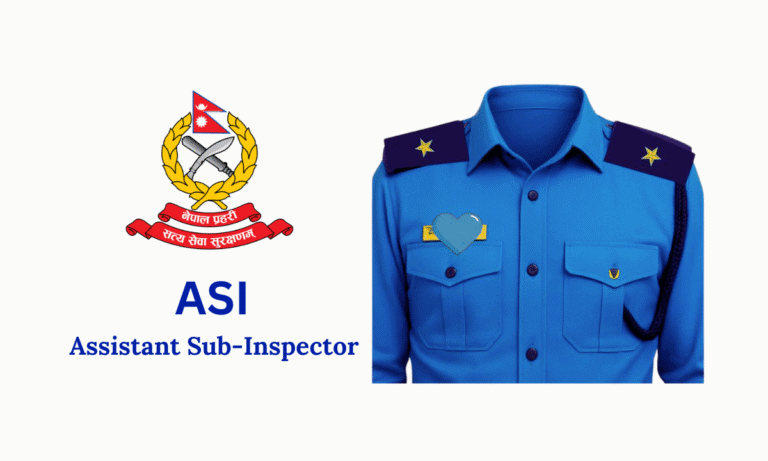
Meanwhile, readers also read this: Step by Step Guide to Becoming an ASI(Assistant Sub-Inspector ) in Nepal Police
Physical Test & Detailed Medical

300-Meter Sprint:
- Boys must complete the race in under 55 seconds.
- Girls must complete the race in under 67 seconds.
High Jump:
- Boys must clear a minimum height of 3 feet.
- Girls must clear a minimum height of 2 feet.
Sit-ups:
- Boys must perform at least 12 sit-ups.
- Girls must perform at least 5 sit-ups.
Push-ups:
- Boys must complete a minimum of 10 push-ups.
- Girls must complete a minimum of 4 push-ups.
Chin-ups / Hanging:
- Boys must complete 3 chin-ups.
- Girls must hang from a bar for at least 30 seconds.
3.2-Kilometer Run:
- Boys must finish the 3.2 km (2 miles) run in 18 minutes or less.
- Girls must complete the 3.2 km (2 miles) run in 21 minutes or less.
Candidates who fail to meet any one of the above physical standards will be disqualified from proceeding to the next stages of recruitment.
All recruitment or promotion processes within the Nepal Police are conducted according to the provisions set in Schedule-8 of the General Principles to be Followed, 2069 B.S.
After passing the physical fitness test, candidates undergo a comprehensive medical evaluation. This includes in depth health checks conducted by certified medical professionals to ensure that the candidate is medically fit for service.
Written Exam

The written examination consists of three separate papers, each designed to assess specific competencies of the candidate:
1. General Ability and Reasoning Test (GART)
- Duration: 50 minutes
- Total Marks: 100
- Format: 50 multiple-choice questions (MCQs)
- 25 questions on General Knowledge
- 25 questions on Reasoning Ability
- Marking Scheme:
- +2 marks for each correct answer
- −0.4 marks deducted for each incorrect answer (20% penalty)
- No marks for unanswered questions
- Passing Marks: Minimum of 40 marks required
- Instructions: Answers must be marked using English capital letters (A, B, C, or D) only.
2. Language Proficiency Test (LPT)
- Duration: 3 hours
- Total Marks: 100 (50 for English, 50 for Nepali)
- Passing Criteria: Minimum 20 marks in each section
- Format: Subjective questions, including essays, comprehension, grammar exercises, and translation
- Answer Sheets: Separate answer booklets for Nepali and English must be used.
English Section Breakdown (10 questions, 2 marks each):
This section assesses grammar, vocabulary, and sentence structure. Key areas include:
- Parts of speech and tense usage
- Sentence formation and word order
- Active/passive voice and reported speech
- Use of relative clauses and appropriate prepositions
- Punctuation and sentence rewriting
- One-word substitutions, synonyms/antonyms
- Word formation (derivatives, prefixes, suffixes)
3. Professional Orientation Aptitude Test (POAT)
- Total Marks: 100
- Components:
- Professional Knowledge (Written Test)
- Duration: 2 hours 15 minutes
- Focus areas:
- Police duties and structure
- Crime investigation and reporting
- Security management
- Law enforcement and legal knowledge
- Patrolling and handling of complaints, especially domestic violence
- Professional Behavior (Behavioral Assessment)
- Duration: 45 minutes
- Marks: 15
- Includes practical exercises such as:
- Travel time estimation (5 marks)
- Incident report writing (5 marks)
- Simulated police task (5 marks)
- Professional Knowledge (Written Test)
To pass this phase, candidates must score a minimum of 40 marks overall.
This comprehensive written examination evaluates a candidate’s reasoning ability, language skills, and understanding of professional police responsibilities, ensuring only the most capable individuals proceed to the next stage.
Competency Test
Presentation skills are a key requirement for police officers, especially in roles involving leadership, communication, or strategic planning. As part of the selection process, candidates may be asked to deliver a structured presentation. This is commonly based on a prior group exercise, a case study, or a given topic.
Candidates are usually provided with relevant information and a limited time to prepare. Presentations are expected to be delivered within a fixed timeframe, and necessary tools or equipment may be made available by the organization. This exercise helps assess the candidate ability to organize thoughts, communicate effectively, and present information clearly and confidently.

Competency-Based Interview
Interviewers assess a candidate suitability through two main types of questions. Scenario based questions are used to evaluate how the candidate would handle specific situations, focusing on decision making and problem solving skills. Experience based questions explore past experiences where the candidate successfully addressed relevant challenges. Together, these questions help determine the candidate’s thought process, ability to manage tasks effectively, and overall competence for the role.
FAQs About Inspector of Nepal Police Complete Guide
What is the rank of Inspector in the police?
An Inspector is a senior ranking officer, positioned above a Sub-Inspector and below an Assistant Superintendent of Police (ASP) or Deputy Superintendent of Police (DSP). Inspectors often lead a police station and supervise a team that includes Sub-Inspectors, Assistant Sub-Inspectors, and other junior personnel.
What is the lowest rank in the police?
The lowest rank in the Nepal Police hierarchy is Police Constable.
What is the qualification required to become an Inspector in Nepal?
Applicants must have completed a bachelor degree or an equivalent qualification from a recognized educational institution.
How can one become a Police Inspector in Nepal?
To become a Police Inspector, candidates must go through a competitive selection process that includes written exams, physical and medical tests, interviews, and behavioral assessments. This process ensures candidates are well prepared for the responsibilities the role demands.
Conclusion
Preparing to become an Inspector in the Nepal Police requires a thorough understanding of the recruitment process and syllabus. Candidates must demonstrate discipline, dedication, and consistent effort. Patience and daily practice are key this position carries significant responsibility, so it is vital to build the mental, physical, and emotional strength needed to fulfill it. Stay focused, train regularly, and maintain a healthy routine.